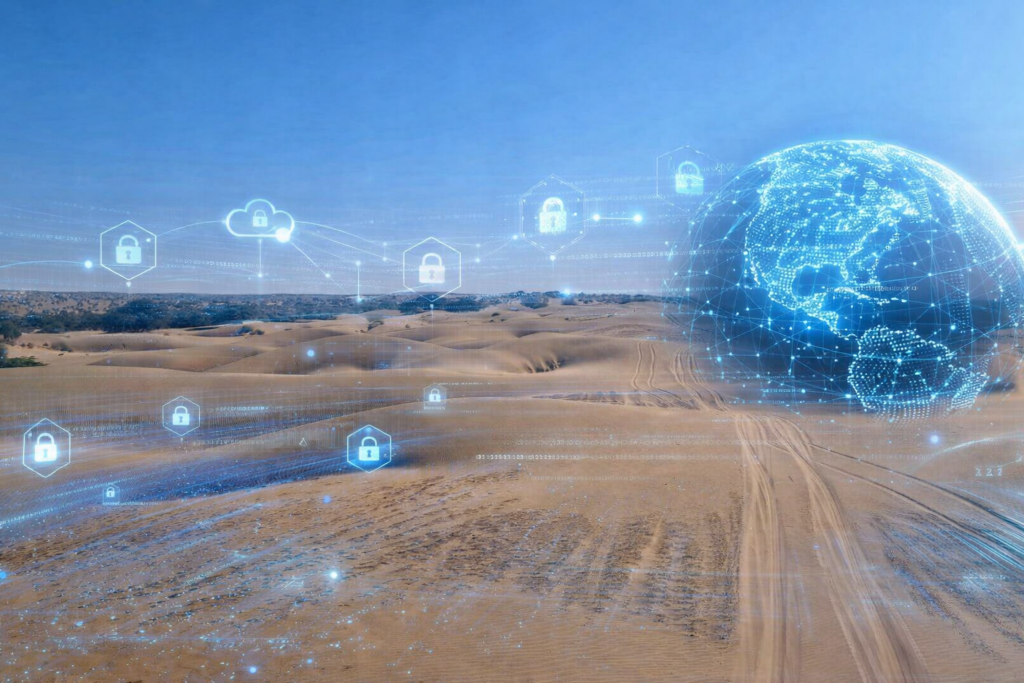
Cyberspace today resembles a desert—vast, unforgiving, deceptive, and survivable only by those who understand its nature
1. Vastness & Exposure
- Desert: Endless open land, no natural cover, threats can appear from any direction.
- Cyberspace: A borderless attack surface—cloud, SaaS, APIs, OT, endpoints—everything exposed by default.
Lesson:
Security is not about walls; it’s about constant awareness and controlled movement.
2. Illusion of Safety (Mirages)
- Desert: Mirages promise water that doesn’t exist.
- Cyberspace: Assumptions like “we’re compliant,” “we have a firewall,” “we’re too small to be targeted.”
Lesson:
False confidence is more dangerous than known risk. Zero Trust exists to kill mirages.
3. Scarcity of Resources
- Desert: Water, shelter, and energy are limited and precious.
- Cyberspace: Security talent, analyst time, clean signals, and response bandwidth are in short supply.
Lesson:
Survival depends on prioritization, automation, and intelligence-driven decisions, not brute force.
4. Hidden Threats
- Desert: Predators hide beneath sand; sandstorms appear without warning.
- Cyberspace: Living-off-the-land attacks, supply-chain compromises, insider threats, zero-days.
Lesson:
Threats are often invisible until movement is detected—hence the need for telemetry, behavior analytics, and NDR/XDR.
5. Movement Requires Trusted Paths
- Desert: Survivors follow known caravan routes, landmarks, and guides.
- Cyberspace: Secure identity, authenticated access, encrypted channels, policy-driven paths.
Lesson:
Access should be earned incrementally, not granted all at once. Identity is the compass.
6. Oases as Control Points
- Desert: Oases are rare, protected, and strategic.
- Cyberspace: SOCs, PAM systems, SIEM/SOAR platforms, recovery vaults.
Lesson:
Critical assets must be isolated, monitored, and defended, not scattered.
7. Survival Is Continuous, Not Event-Based
- Desert: You don’t “finish” the desert—you constantly adapt to it.
- Cyberspace: There is no “secure state,” only continuous verification and response.
Lesson:
Security is a living system, not a checklist.